How to Build a Bully Reporting Culture Students Trust
Most schools have some way for students to report bullying. A form in the counselor's office. A suggestion box in the hallway. An email address on the website. And most of those systems sit largely unused — not because students don't witness bullying, but because they don't trust that reporting will help rather than hurt.
The barrier isn't awareness. Students know bullying is wrong, and many of them want to do something about it. The barrier is fear — fear of retaliation, fear of being labeled a snitch, fear that adults will overreact or underreact, and a quiet, persistent suspicion that nothing will actually change. Until you address those fears directly, any reporting mechanism you build will underperform.
Building a bully reporting culture that students genuinely trust is a long-term project. It requires structural changes, consistent adult behavior, and an honest look at how students currently experience your school. Here's how to approach it.
Understand Why Students Don't Report Now
Before redesigning any system, it's worth diagnosing the actual problem. The reasons students stay silent tend to cluster into a few predictable categories:
- Fear of social consequences. Being seen as a tattletale carries real social risk, especially in middle school. Students weigh the cost of reporting against their friendships and social standing — and often decide silence is safer.
- Doubt that adults will help. If students have reported in the past and nothing changed — or worse, the situation escalated after adults got involved — they have learned not to bother. That lesson sticks.
- Fear of retaliation from the person they're reporting. When students worry the accused will find out who reported them, the risk calculus tips sharply toward silence.
- Uncertainty about what counts as reportable. Students aren't always sure whether what they witnessed is serious enough to mention. Without clear guidance, many default to inaction.
- Distrust of the process itself. If the reporting mechanism feels bureaucratic, cold, or opaque, students disengage before they even start.
Key point: Silence is rational when students don't trust the outcome. Fixing the reporting mechanism won't work until you fix what happens after a report is made.
A useful starting point is a brief, anonymous student survey — not about bullying itself, but about why students have or haven't reported it in the past. You may be surprised by how clearly students can articulate the exact friction points in your current system.
Make Anonymity Real — and Perceived as Real
Anonymity is the single most powerful lever for increasing report volume, but it only works if students genuinely believe their identity is protected. A lot of schools claim anonymity while inadvertently undermining it.
Consider the common scenario: a student fills out a paper form, walks it to a specific teacher's classroom, and hands it over in view of classmates. Technically anonymous. Practically, not at all.
What genuine anonymity requires
For students to trust that a report is truly anonymous, several things need to be true simultaneously:
- The submission method must be private — no one can see them submitting, and the report doesn't contain identifying metadata.
- The information in the report shouldn't make it easy to reverse-engineer who reported it. Students need to know that details that could identify them will be handled carefully.
- Staff who receive reports must be explicitly trained not to investigate in ways that would expose the reporter's identity.
- Students need to hear, repeatedly and concretely, how the anonymity works — not just a vague assurance that it does.
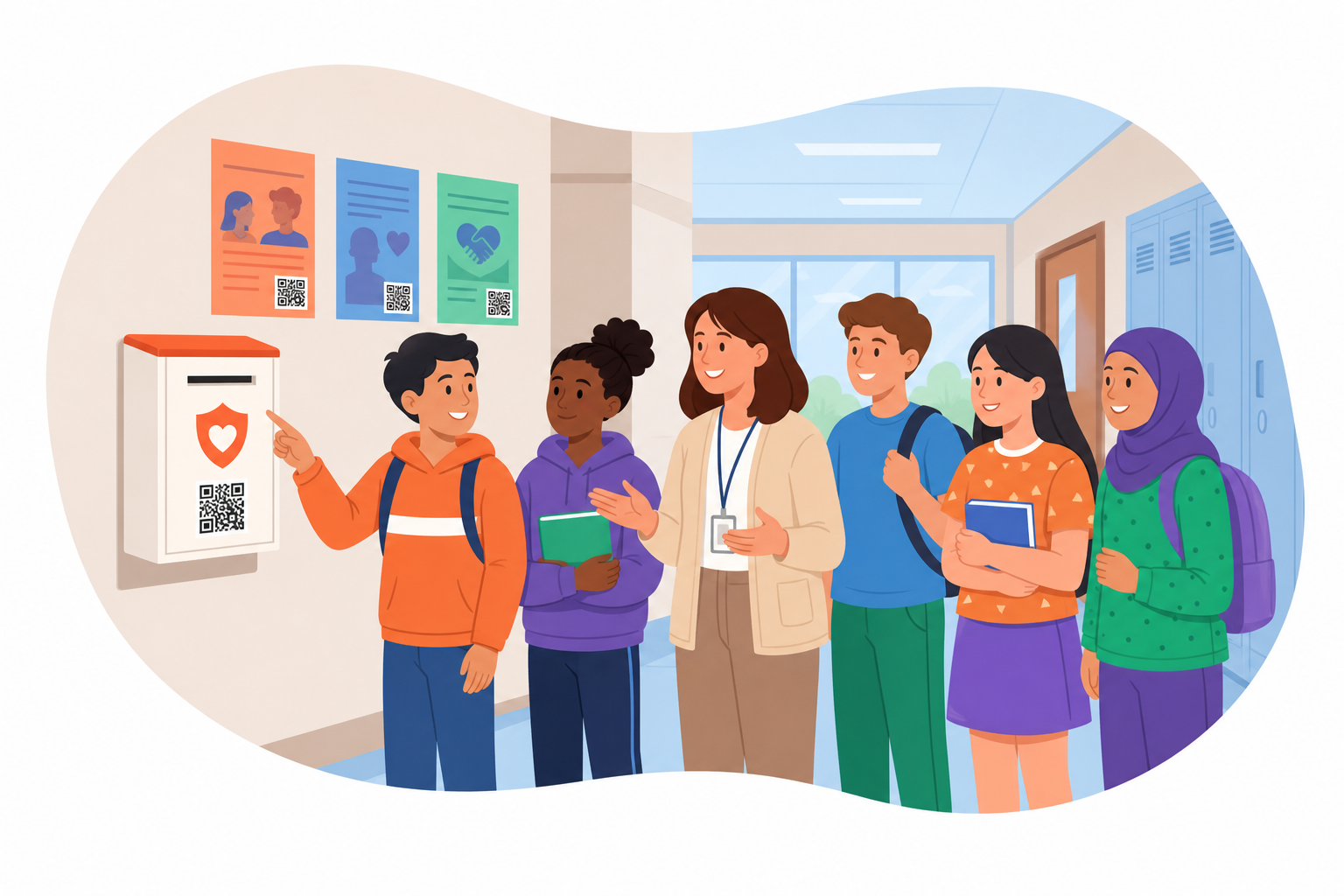
Digital reporting tools have a significant advantage here. Platforms like WhispAlert use QR codes posted around school that students can scan from any device, submit a report without logging in or entering their name, and walk away with no traceable connection to the submission. The physical act of reporting is invisible to peers. That matters more than most adults realize.
Close the Feedback Loop Every Time
This is where most well-intentioned reporting systems fail. A student takes the risk of submitting a report. They wait. Nothing visible changes. The bully keeps doing exactly what they were doing. The student concludes that reporting was pointless — and they tell their friends the same.
You don't have to share the outcome of an investigation with the reporter. You can't always do that, and confidentiality around discipline is appropriate. But you can communicate that the report was received, that it was taken seriously, and that action was taken — even if the details must stay private.
Simple ways to close the loop
- If your reporting system allows two-way messaging without revealing identity, use it. Acknowledge every report within 24 hours.
- For anonymous reports where you can't message back, make your response visible in the school environment — an increased adult presence in a reported area, a classroom conversation about respect, a check-in with the targeted student.
- Periodically share aggregate data with students. Something as simple as "We received 14 reports last month and followed up on every one" demonstrates that the system works.
- Train counselors and administrators to check in casually and privately with students who may have reported something — without confirming whether they did.
Pro tip: Some schools designate a specific counselor as the visible "owner" of the reporting system. When students know there's a real human — someone they recognize and trust — on the other end, report rates tend to climb. Anonymity and a known, trusted adult aren't contradictory; they complement each other.
Train Staff to Respond Without Making It Worse
A student who sees a trusted adult fumble a bullying situation — publicly confronting the accused, demanding to know who told them, or dismissing the concern as drama — will not report again. Neither will the students who witnessed that response.
Adult response quality is the variable that student bystanders are watching most closely. They're running a silent cost-benefit analysis every time they see an incident handled: Is this worth reporting? Will they help or make it worse?
Core staff training principles
- Never reveal or hint at a reporter's identity. Even saying "someone mentioned this to me" can be enough for a savvy student to figure out who reported. Staff should simply respond to what they've observed or learned without attribution.
- Respond proportionately. Overreaction can embarrass the targeted student and invite more teasing. Under-reaction signals that reporting doesn't work. Calibrated, consistent responses build credibility.
- Follow up privately with targeted students. A quiet check-in after an incident — not a public acknowledgment — shows care without creating additional social risk for the student.
- Document consistently. Every report should go into a log, even if the initial assessment is that it's minor. Patterns matter, and what looks minor in isolation may look very different as part of a series.
- Treat bystander reports with equal seriousness as victim reports. Students who report on behalf of someone else are taking a significant social risk. That courage deserves explicit acknowledgment and careful handling.
Build a School Culture That Normalizes Speaking Up
Structural changes to your reporting system matter, but they operate inside a broader school culture. If the social norm is that reporting is weak or disloyal, even the best anonymous system will underperform. Culture change requires deliberate, sustained effort.
Shift the language
The word "report" still carries connotations of tattling for many students. Some schools have had success reframing it entirely — talking about "looking out for each other," "having someone's back," or "letting someone know." The behavior is the same; the social meaning shifts.
Use student voice authentically
Students are far more persuasive to other students than adults are. Peer-led campaigns, student government messaging, or short videos made by students explaining why they report (without sharing specific situations) can change the perceived social norm around speaking up.
Highlight outcomes without violating privacy
Schools can communicate, carefully, that reports led to real change — a student got support, a situation improved, someone felt safer. You don't need to name names. The message that "this works" is what matters.
Make it part of advisory and classroom culture
Regular, low-stakes conversations about bystander responsibility, empathy, and what it means to be a good community member normalize the idea of speaking up before a student is faced with a real situation. Advisory periods, morning meetings, and health class are all natural venues.
Make the System Visible and Accessible Everywhere
A reporting system that students have to seek out will be underused. The access point needs to be where students already are — in the cafeteria, near bathrooms, in hallways, in the gym locker room areas. Not just on a page buried on the school website.
QR-code-based systems work well in this context because the access point (the poster) can be placed anywhere, and the submission happens on a personal device with no need to seek out a specific adult or location. WhispAlert, for example, is designed around exactly this kind of passive accessibility — the tool is always there, in the background, ready when a student decides they want to use it.
Accessibility also means thinking about language. If a significant portion of your student population speaks a language other than English at home, your reporting prompts should be available in those languages too. Reporting under stress is hard enough without an additional language barrier.
Key point: The harder it is to report — in steps, in distance, in social visibility — the fewer reports you'll receive. Every friction point you remove increases the likelihood that a student who decides to speak up will actually follow through.
Measure What's Working and Adjust
Reporting culture isn't built once and then finished. It requires ongoing attention and honest assessment. A few indicators worth tracking over time:
- Report volume trends. Are you receiving more reports over time? A rising trend (up to a point) is usually a sign of growing trust, not a sign that bullying is getting worse.
- Report type distribution. Are reports coming from a broad cross-section of your student population, or concentrated in specific grades or demographics? Gaps may indicate trust problems in certain groups.
- Time to follow-up. How quickly are reports acknowledged and acted on? Slow response times erode trust even when students can't see the investigation itself.
- Student perception surveys. Annual or semester surveys asking students whether they believe reporting is safe and useful give you a direct read on whether your efforts are landing.
Building a Trusted Reporting Culture: Action Checklist
- Survey students to identify specific barriers to reporting in your school
- Audit your current reporting method for anonymity gaps — physical, digital, and procedural
- Establish a clear, documented protocol for responding to every report within 24 hours
- Train all staff on protecting reporter identity and responding without escalating
- Place reporting access points (digital or physical) throughout the school building
- Ensure reporting prompts are available in all languages spoken by your students
- Designate a visible, trusted staff member as the face of the reporting system
- Integrate bystander responsibility into advisory, health, or homeroom curriculum
- Use student voice — peer campaigns, student government — to shift social norms around speaking up
- Track report volume, response time, and student perception on a regular schedule
- Share aggregate outcomes with students to demonstrate the system works
The goal isn't a school where students report everything. It's a school where students feel confident that when something serious is happening — to them or to someone they know — there's a safe, real path to getting help. That confidence doesn't come from a poster on the wall or a form on the website. It comes from the experience of watching adults follow through, protect identities, and actually make things better. Build that track record, consistently, and the culture will follow.
Ready to Make Your School Safer?
Join hundreds of schools already using Whispalert to create safer, more supportive learning environments.
Get Started Today