How to Build a Threat Assessment Team in Your School
Every few months, a school somewhere makes national news because a threat was reported — and nothing happened. No one followed up. No one connected the dots. Sometimes the warning signs were there for weeks. The problem usually isn't that staff didn't care. It's that nobody had a clear role, a clear process, or a clear team responsible for acting on what they knew.
A behavioral threat assessment team is the structural fix for that gap. It's not a security measure in the traditional sense — no metal detectors, no surveillance cameras. It's a small, cross-functional group of trained staff who evaluate concerning behavior before it escalates into something worse. Done well, it's one of the highest-leverage safety investments a school can make.
Here's how to build one that actually functions.
What a Threat Assessment Team Actually Does
Before assembling people, it helps to be precise about the team's purpose. A threat assessment team is not a disciplinary committee. Its job isn't to decide punishment — it's to evaluate risk and coordinate a response that reduces harm. Those two functions can conflict, which is why keeping them structurally separate matters.
The team's core work involves three things:
- Gathering information about a student who has made a threat or shown concerning behavior
- Evaluating the seriousness of that behavior on a spectrum from transient to substantive
- Coordinating a response — which might be a counseling referral, a parent conference, a safety plan, law enforcement involvement, or some combination
The goal is to connect students who are struggling with support, while also protecting the school community if a genuine danger exists. Most cases turn out to be on the lower end of the risk spectrum — a frustrated student who said something impulsive. A well-functioning team handles those quickly and quietly, reserving intensive response for situations that warrant it.
Key point: Threat assessment is not about punishing kids for saying scary things. It's about understanding what's driving the behavior and intervening at the right level — early enough to prevent escalation.
Who Should Be on the Team
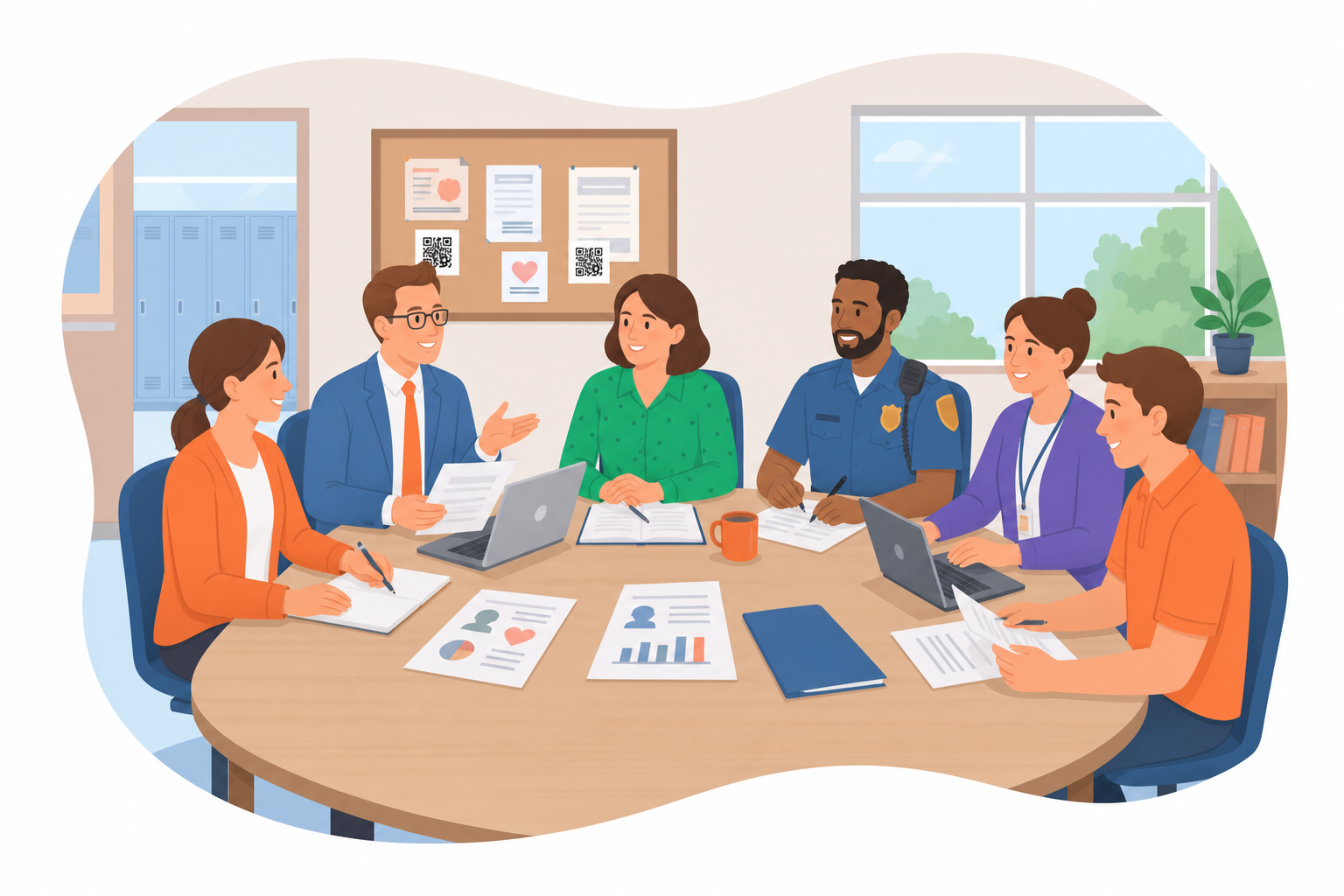
Most experts in school-based behavioral threat assessment recommend a core team of three to five people, with the ability to bring in additional perspectives when needed. Bigger isn't better here — you want people who can meet quickly, communicate openly, and make decisions without a committee process that takes days.
Core Members
These roles should be present on every assessment team, regardless of school size:
- A school administrator (principal or assistant principal) — someone with authority to make decisions and communicate with families
- A school counselor or psychologist — the clinical anchor of the team, trained to evaluate mental health context and connect students to services
- A school resource officer or safety coordinator — provides law enforcement perspective and handles coordination with outside agencies when necessary
Extended Team Members
Depending on the case, you'll want to pull in additional voices. These might include:
- The student's current teachers or advisor
- A social worker, if the school has one
- A special education coordinator, if the student has an IEP or 504 plan
- Outside mental health providers, with appropriate releases in place
At smaller schools where one person wears multiple hats, the team may look different — what matters is that the key functions (administrative authority, clinical lens, safety coordination) are all represented by someone.
Pro tip: Designate a team lead whose job is to receive reports, convene the team, and track cases to resolution. Without a single point of accountability, referrals slip through the cracks — especially during busy stretches of the school year.
How to Structure the Process
A team without a process is just a list of names. The protocol is what gives the team its consistency and credibility. Here's a practical framework built around five steps.
1Establish a Clear Reporting Pathway
Staff, students, and parents need to know how to report a concern — and that reporting is expected, not optional. Many schools struggle here because reporting feels vague or risky. Teachers worry about overreacting. Students worry about being labeled a snitch.
Make the pathway concrete: a specific staff member to contact, a form to submit, or an anonymous reporting channel. Schools using anonymous digital reporting tools — like WhispAlert — often see more tips from peers, who frequently know something is wrong before adults do. Whatever the channel, it should be posted visibly and communicated regularly.
2Triage Within 24 Hours
When a report comes in, the team lead needs to make an initial triage call quickly. Is this something that warrants immediate action (law enforcement notification, removal from campus), or can it move through a standard evaluation process? Most situations fall into the latter category, but that determination needs to happen fast — not at the next scheduled meeting three days away.
Create a simple triage checklist your team lead can use independently before convening the full team. Red flags that typically escalate to immediate response include: specific plan, specific target, access to weapons, or expressed intent to act soon.
3Gather Information From Multiple Sources
A threat assessment is only as good as the information behind it. Once the team convenes, its first job is to build a fuller picture of the student. This usually means:
- Reviewing disciplinary and attendance records
- Speaking with teachers, coaches, and other staff who know the student
- Interviewing the student themselves — in a non-accusatory, curious posture
- Contacting parents or guardians
- Reviewing social media if there are public posts relevant to the threat
The student interview is often the most valuable step and the most underused. Most students who are struggling — even those who have said something alarming — are willing to talk when approached with genuine concern rather than suspicion.
4Classify the Threat and Determine Response
Most behavioral threat assessment frameworks organize threats into two broad categories: transient and substantive. A transient threat is one that, in context, doesn't reflect genuine intent — an angry outburst, a dark joke taken out of context, frustration vented in a moment. A substantive threat indicates the student may have real intent to harm.
This classification drives the response. Transient threats typically warrant a restorative conversation with the student and communication with the family. Substantive threats require a more intensive response: a safety plan, possible law enforcement contact, mental health evaluation, and close monitoring.
Some teams use a third tier — serious substantive threats — for situations involving specific plans, named targets, or access to weapons, where law enforcement involvement is immediate.
5Document Everything and Follow Up
Every case should be documented — what was reported, what the team found, what was decided, and what happened afterward. This matters for three reasons. First, it protects the school legally. Second, it creates a record that's useful if the student's behavior changes later. Third, it helps you see patterns across students and time.
Documentation doesn't have to be elaborate. A structured case file with standard fields is more useful than a long narrative. The team lead should set a follow-up date for every open case and close cases explicitly when the situation is resolved.
Training and Legal Grounding
A threat assessment team operating without training is a liability, not an asset. Team members need to understand both the practical protocol and the legal framework around student privacy, mandatory reporting, and due process.
What Training Should Cover
- Behavioral threat assessment frameworks — the most widely used in K-12 settings are the Virginia Student Threat Assessment Guidelines (VSTAG) and the SIGMA model, both of which have research support and structured protocols
- Trauma-informed interviewing — how to talk with students in a way that's productive rather than adversarial
- FERPA and confidentiality — what information can be shared within the team and with outside parties, and when consent is required
- Implicit bias awareness — research consistently shows that students of color and students with disabilities are more likely to be referred for disciplinary action; threat assessment teams need to interrogate their own patterns
State Requirements
A growing number of states now require schools to have formal threat assessment teams and protocols in place. Requirements vary significantly — some mandate specific frameworks, some require annual training, some specify team composition. Check your state education agency's current guidance; this landscape has shifted considerably in recent years and continues to evolve.
Key point: Even in states without a mandate, establishing a threat assessment team demonstrates good-faith effort to protect students — which matters both ethically and legally if an incident ever occurs.
Common Pitfalls to Avoid
Schools that build threat assessment teams sometimes find that the team doesn't function well in practice. Here are the failure modes that come up most often:
The team only meets when there's a crisis.
Regular meetings — even monthly check-ins to review open cases and discuss patterns — keep the team sharp and prevent cases from going stale. Threat assessment is an ongoing function, not a break-glass-in-emergency one.
Reporting is inconsistent because staff don't trust the process.
If teachers report concerns and never hear anything back, they stop reporting. Build in a feedback loop — it doesn't require sharing confidential details, just confirming that the concern was received and addressed.
The team skews punitive.
When administrators dominate the team and disciplinary culture is strong, teams sometimes default to suspension or expulsion rather than support. This tends to make students less safe, not more — a student who's been pushed out of school and feels humiliated is a higher-risk student, not a lower one.
Documentation is ad hoc or nonexistent.
If a case resurfaces six months later and the team can't reconstruct what happened the first time, the documentation failed. Templates help. So does designating a single person responsible for records.
The team isn't connected to outside resources.
Many threat assessment responses involve referring students to community mental health services, crisis intervention, or other outside supports. If the team doesn't have those relationships built in advance, they have to start from scratch in the middle of a crisis. Map your community resources now, before you need them.
Pro tip: Tools like WhispAlert can help close the gap between when students notice something worrying and when adults find out about it. Peer reports submitted anonymously through QR codes posted around the school often surface concerns that would otherwise stay invisible — giving your team more lead time to act thoughtfully rather than reactively.
Building a Culture Where the Team Can Succeed
A threat assessment team is most effective when it operates inside a school culture that takes safety seriously without treating students as suspects. That means a few things at the school-wide level:
- Students need to trust that reporting leads to help, not just punishment. If the school's general culture is punitive, students won't come forward — even when they're genuinely worried about a peer.
- Staff need to feel confident making referrals. Regular professional development on warning signs, combined with clear and simple reporting procedures, reduces the hesitation that lets concerning situations go unaddressed.
- Families need to understand the team's purpose. Communicating proactively — in back-to-school materials, in handbooks — that the school has a structured process for addressing threats helps reduce panic when a situation does occur.
The team is a mechanism. The culture is what makes it run. Schools with strong adult-student relationships, clear norms around reporting, and a genuine commitment to student wellbeing get more out of their threat assessment teams than schools that treat it as a compliance checkbox.
Threat Assessment Team Setup Checklist:
- Identify and formalize core team members (administrator, counselor/psychologist, SRO or safety coordinator)
- Designate a team lead responsible for receiving reports and tracking cases
- Establish and communicate a clear reporting pathway for staff and students
- Develop a triage protocol for immediate vs. standard-response situations
- Select and train the team on a structured assessment framework (e.g., VSTAG or SIGMA)
- Create case documentation templates and a secure file system
- Map community mental health and crisis resources before you need them
- Schedule regular team meetings — not just crisis-driven ones
- Build a feedback loop so staff who report concerns hear that action was taken
- Review state requirements and ensure your protocol meets or exceeds them
Ready to Make Your School Safer?
Join hundreds of schools already using Whispalert to create safer, more supportive learning environments.
Get Started Today