How to Talk to Students After a Bullying Report
A bullying report lands on your desk — maybe through an anonymous tip, a teacher referral, or a parent call. You know something happened. Now comes the part that can either build trust or quietly destroy it: talking to the students involved. How you handle those first conversations shapes whether students will ever report again, whether the target feels safe, and whether real change actually follows.
Most adults in schools care deeply about getting this right. The challenge isn't motivation — it's knowing exactly what to say, in what order, and how to hold space for everyone without tipping the scales before you have the full picture.
Before You Say a Word: Set the Conditions
The environment where you speak with students matters as much as the words you choose. A conversation pulled in the hallway between bells sends a very different message than one held in a calm, private space. Before any student sits down across from you, make sure a few basics are in place.
Choose the Right Setting
Use a private room — not your office with the glass wall facing the main hallway. Students who were targeted often scan the environment to assess how safe it is to be honest. Students who may have done harm will close down if they feel exposed or embarrassed in front of peers. Privacy protects both groups.
Notify Caregivers Appropriately
Know your district's policy on when parents must be contacted before or during an interview. In many cases, particularly when the reported behavior is serious or involves younger students, a guardian call should happen first. Skipping this step can undermine the process later — and occasionally escalate situations you were trying to de-escalate.
Talk to Students Separately — Always
Never bring the reported target and the reported aggressor into the same conversation until you have heard each account independently, ideally not until a much later restorative step. Joint interviews contaminate accounts, can retraumatize the target, and often produce the social performance of reconciliation rather than genuine resolution.
Key point: The sequence of your interviews matters. Start with the student who made the report or was targeted. Their account is your foundation. Speak with bystanders next if any have been identified, then the student accused of the behavior.
Talking With the Student Who Was Targeted
This conversation carries the most emotional weight. The student in front of you may be frightened, embarrassed, unsure whether reporting was the right call, or worried about retaliation. Your job in the first few minutes is not to gather facts — it's to make them feel safe enough to tell you the truth.
Open Without Pressure
Avoid leading questions. Don't open with "So I heard Marcus has been giving you a hard time" — that immediately signals what you already believe and can either confirm a student's fear that the situation is worse than they let on or make them feel like they have to perform distress. Instead, try something like: "I wanted to check in with you. Can you tell me what's been going on for you lately?"
Let silence sit when it needs to. Students who have been bullied — especially over a sustained period — often haven't rehearsed telling adults. They may need a moment.
Validate Without Promising Outcomes
There's a specific trap many well-meaning counselors and administrators fall into: over-promising. Saying "This is never going to happen again" before you've completed an investigation puts you in an impossible position and, if things do continue, destroys your credibility with that student permanently. Instead, validate what they're feeling and be honest about the process: "What you're describing sounds really hard. I take this seriously, and I'm going to look into it carefully."
Cover Safety Planning Before They Leave
Before the student walks back into the building, make a concrete plan with them. Who can they go to if something happens today or tomorrow? What should they do if the behavior escalates? Do they have a trusted adult in their classroom or on their bus? A student who leaves your office with a safety plan in hand feels measurably more supported than one who leaves with a vague "let me know if anything else happens."
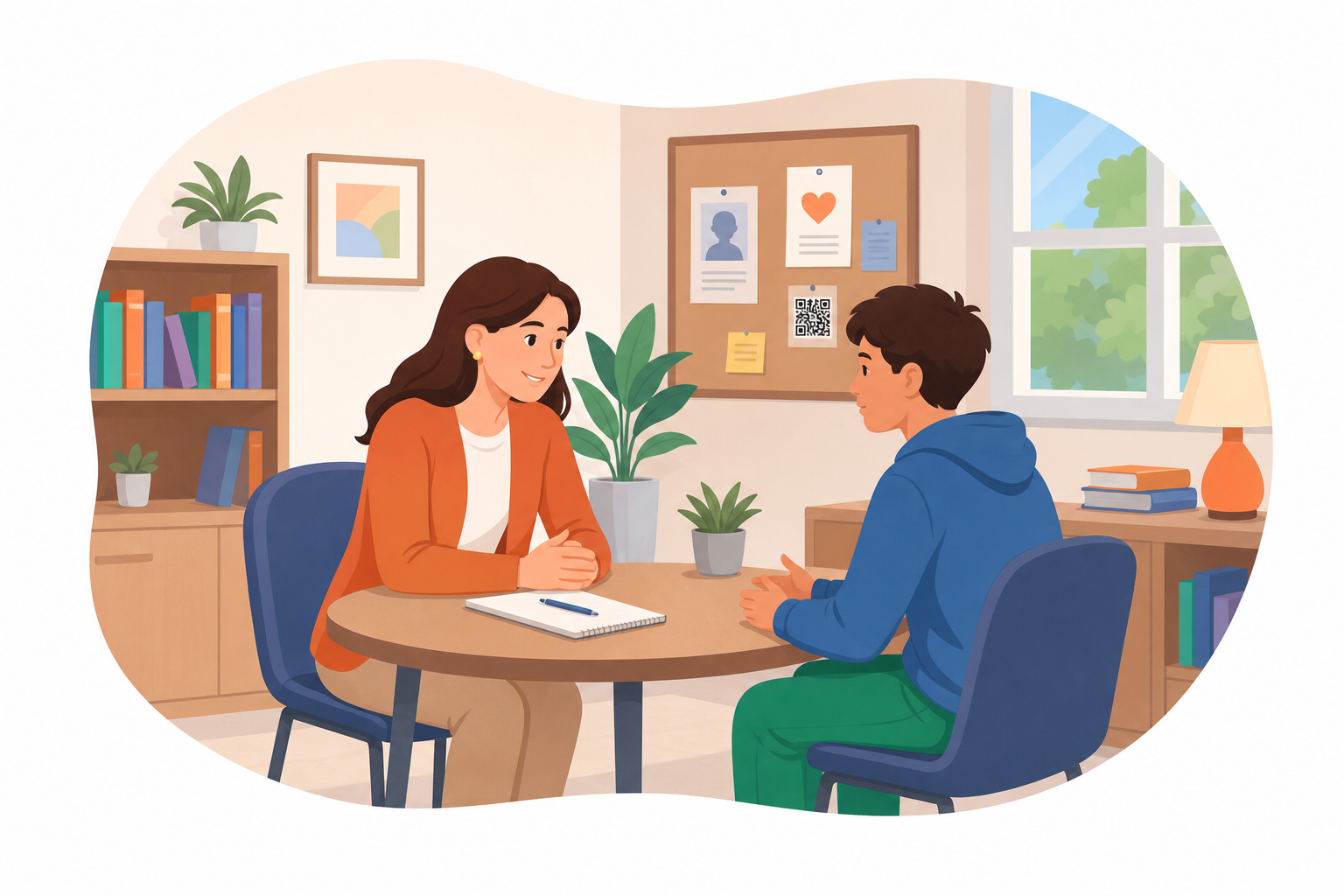
Talking With Bystanders
Bystanders are often overlooked in the interview sequence, but they can provide the clearest picture of what's actually happening — precisely because they're not at the center of the conflict and may be less emotionally activated. They also carry their own burden: many bystanders feel guilty for not intervening or worried about becoming a target themselves.
Protect Their Identity When You Can
Be explicit with bystanders: "I'm talking with several people who may have seen different things. I'm not going to tell anyone who specifically said what." This is especially important in schools where social reputations are fragile and students fear being labeled a snitch. If a bystander knows their account won't be directly attributed to them, you are far more likely to get honest detail.
Ask What They Saw, Not What They Think
Keep bystander interviews behavioral and concrete. "What did you see?" and "What did you hear?" produce better information than "Do you think he was bullying her?" The latter invites judgment and social calculation; the former invites observation. Students are generally much better at describing behavior than interpreting it, and that's exactly what you need.
Talking With the Student Accused of Bullying
This is the conversation most adults feel least confident about — and the one most likely to go sideways. The natural instincts (to confront, to lecture, to demand an apology) are often the least effective moves you can make.
Come In Curious, Not Conclusive
Even when you're fairly confident about what happened, enter this conversation genuinely open. Students accused of bullying who feel immediately condemned rarely respond with honesty or genuine reflection. They respond with denial, deflection, or performance. Open with: "I want to hear your perspective on some things that have come to my attention. I'm not here to accuse you — I want to understand what's been going on."
This doesn't mean minimizing what was reported. It means creating the conditions where the student is more likely to tell you something true.
Avoid the Shame Spiral
Research in adolescent psychology and restorative practices consistently points to the same finding: shame tends to escalate harmful behavior rather than reduce it. Students who feel globally condemned — "you're a bully, you're cruel, you're the problem" — often become more defensive and more aggressive. Students who feel that a specific behavior is being addressed, while they themselves are still seen as capable of doing better, are more likely to shift. The goal is to separate the behavior from the identity: "What you did had a real impact on someone. That matters. I also know that's not the only thing you are."
Be Clear About Consequences and Process
Don't leave this conversation vague. Explain what the next steps are, what documentation will happen, and if relevant, what the school's discipline policy involves. Students — and their parents — respond better to a clear, fair process than to uncertainty. Uncertainty breeds rumors, and rumors rarely help.
Pro tip: If a student discloses something during this conversation that suggests they themselves are experiencing stress, instability at home, or victimization elsewhere, note it. Students who bully others are sometimes experiencing significant harm themselves. That doesn't excuse the behavior, but it does inform how you support and follow up with them.
Documentation and Follow-Through
The conversations themselves are only half the work. What happens in the days and weeks after determines whether your response was an event or a genuine intervention.
Write It Down Carefully
Document each conversation as soon as possible — ideally within the hour. Note what was said, not your interpretation of what was meant. Use behavioral language: "Student reported that on three occasions during lunch, the other student knocked her lunch tray and called her names" rather than "Student says she's being bullied." Precise documentation protects you legally and creates a cleaner record if behavior continues and escalates.
Check Back With the Target
One of the most common failures in bullying response is the absence of a follow-up conversation with the targeted student. Studies of student experience consistently show that targets often feel most abandoned not when the initial incident occurs, but when adults take action and then disappear. A brief five-minute check-in three to five days later — "I wanted to see how things have been going" — sends a powerful message that this isn't over just because the formal process is.
Monitor the Social Climate
Ask teachers who have the involved students in class to keep an informal eye on interactions without making it surveillance theater. Often, patterns of exclusion, whispering, or physical avoidance will reveal whether a situation has resolved or gone underground. Peer dynamics are subtle; you need multiple observers over time, not a single interview.
When the Report Was Anonymous
An increasing number of bullying reports arrive through anonymous channels — including platforms like WhispAlert, where students can flag concerns through QR codes without identifying themselves. These reports require a slightly different approach to interviews, because you often can't start by asking the reporter to fill in details.
When working from an anonymous tip, the investigation relies more heavily on bystander accounts and behavioral observation. Be careful not to reveal the existence of an anonymous report in a way that could narrow down who submitted it. Phrasing like "Some concerns have been brought to my attention" is more protective than "I got a report about this." The entire value of anonymous reporting infrastructure depends on students trusting that the anonymity is real.
A Note on Restorative Options
Once individual conversations are complete and the immediate situation is addressed, many schools move toward a facilitated restorative conversation between the parties — but only when both students are genuinely ready and it is appropriate to the situation. Restorative conversations are not mandatory reconciliation. They work when both the target and the person who caused harm have had adequate time to process, when safety is established, and when a trained facilitator guides the exchange.
Used well, restorative approaches can produce outcomes that discipline alone rarely achieves: genuine understanding of impact, authentic accountability, and a school climate where students believe relationships can be repaired. Used poorly — rushed, forced, or treated as a box to check — they can retraumatize and erode trust further.
The individual conversations described in this article are prerequisites for any restorative step. You cannot rush toward resolution before you've done the patient work of listening to each person separately.
Post-Report Conversation Checklist:
- Private, calm setting secured before any interview begins
- Caregiver notification completed per district policy
- Targeted student interviewed first, separately
- Safety plan created with targeted student before they leave
- Bystanders interviewed with confidentiality assured
- Accused student interviewed with curious, non-conclusive framing
- All accounts documented in behavioral, not interpretive, language
- Follow-up check-in with targeted student scheduled within 3-5 days
- Classroom teachers briefed to monitor social dynamics informally
- Restorative conversation considered only after individual steps are complete
Every bullying report is a student trusting — however tentatively — that telling an adult might actually help. How you respond to that trust in the conversations that follow either confirms or disproves it. Schools that get this right don't just resolve individual incidents; they build the kind of climate where students believe reporting is worth it, which means more problems surface early, when they're still manageable.
Ready to Make Your School Safer?
Join hundreds of schools already using Whispalert to create safer, more supportive learning environments.
Get Started Today