How to Train Staff to Respond to Bullying Reports
A student finally tells someone about the bullying they've been experiencing for weeks. They choose a custodian they trust, not the principal. The custodian listens — then says, "I'll let your teacher know" — and never follows up. The student stops reporting. The bullying continues.
That scenario plays out in schools more often than most administrators realize. The gap isn't always in policy. It's in preparation. Staff members across every role — teachers, aides, coaches, front-desk staff, bus drivers — are often the first to hear about bullying, yet most receive little to no training on what to do in that moment. What they say, how they document it, and what happens next can determine whether a student feels safe enough to keep talking.
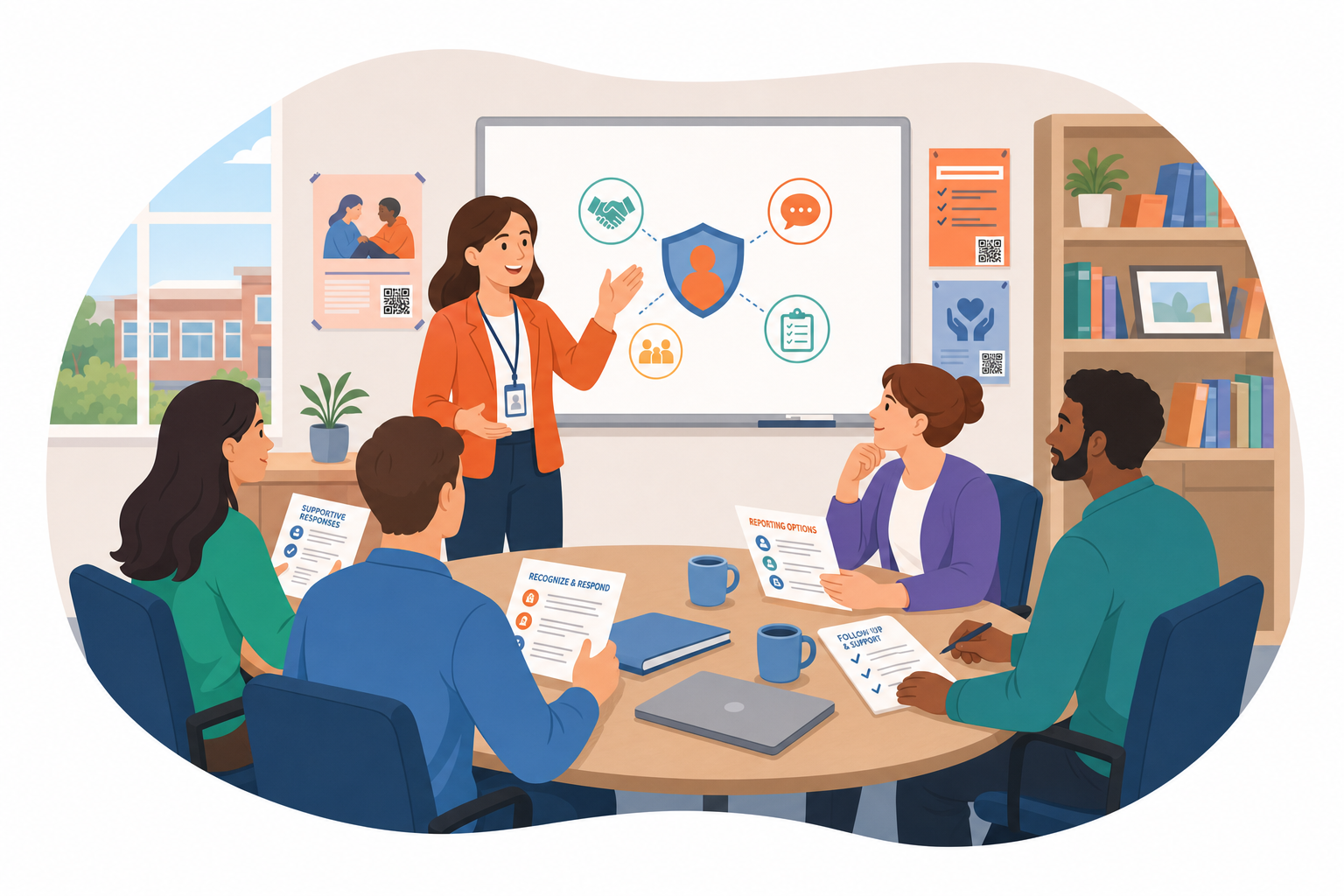
This article offers a practical framework for training your entire staff — not just counselors — to respond to bullying reports effectively, consistently, and with the student's wellbeing at the center.
Why Whole-Staff Training Matters
Most schools have a designated bullying response team — perhaps a counselor, an assistant principal, and a few key teachers. But students don't choose to report based on job titles. They report to the adult they feel comfortable with at the moment it becomes too much to carry alone.
When only a handful of people are trained, you create a fragmented response. Reports get lost in translation. Some staff respond warmly but informally, with no documentation. Others overreact in ways that embarrass the reporting student. Some unknowingly minimize the experience. Each inconsistency erodes student trust in the system.
Key point: Bullying response is only as strong as your least-prepared staff member. When every adult knows the basics — how to listen, what to document, and who to hand off to — your entire school becomes safer by default.
Whole-staff training doesn't mean every employee becomes an investigator. It means every employee knows how to receive a report with care, respond without doing harm, and connect it to the right person quickly.
The Four Stages of an Effective Bullying Response
Before training content can be designed, it helps to map out the stages your staff will be trained on. Most effective responses follow four distinct phases:
1Receive the Report
This is the moment a student (or bystander) shares what happened. Staff need to know how to create a safe space immediately — even in the middle of a busy hallway. This means stopping what they're doing, making eye contact, using open body language, and saying something that signals belief: "I'm glad you told me. I want to hear what happened."
What staff should not do at this stage: ask leading questions, suggest the student may have misunderstood, compare the situation to "normal conflict," or promise outcomes they can't guarantee.
2Document Accurately
Immediately after the conversation — not days later — staff should capture the key facts: who was involved, what was said or done, when and where it occurred, whether there were witnesses, and how the student seemed emotionally. This doesn't require a long form. A short, consistent template helps staff capture what matters without overthinking it.
Documentation also protects staff. If a situation escalates and families push back, clear records of what was reported and when create an accountable paper trail for the school.
3Hand Off to the Right Person
Every school should designate a clear bullying response lead — typically a counselor, dean, or assistant principal — and every staff member should know exactly who that person is, how to reach them, and what information to pass along. A warm handoff is better than a cold one: walking the student to the counselor's office together, rather than simply saying "go talk to Ms. Rivera," sends a message that the staff member took it seriously.
4Follow Up With the Reporter
This step is the most commonly skipped — and the most important for rebuilding trust. The staff member who received the original report should check in with the student within a day or two, even if they weren't the one who handled the investigation. A simple "I wanted to make sure you're doing okay" closes the loop and signals that reporting leads to action, not silence.
Pro tip: Create a visual "bullying response card" — credit-card sized or posted in staff areas — that summarizes the four stages in plain language. Staff who are nervous about saying the wrong thing will feel more confident with a quick reference they can glance at before approaching a student.
Designing the Training Itself
Knowing what to teach is one thing. Delivering it in a way that actually changes behavior is another. Here's how to structure staff training that sticks.
Use Role-Play Scenarios, Not Just Slides
Passive training — watching a presentation, signing a form — rarely changes how people act in the moment. The most effective bullying response training puts staff in realistic scenarios where they practice the words out loud. Pair up a teacher with a paraprofessional and have them take turns being the student and the adult. The discomfort of not knowing what to say in a role-play is far better than discovering it in front of a real student.
Scenarios should reflect situations your school actually faces. A middle school scenario looks different from an elementary one. A scenario involving cyberbullying that spills into school requires different language than one involving physical intimidation in the locker room.
Address Common Mistakes Directly
Instead of only teaching what to do, explicitly name the missteps that happen in real schools:
- Telling a student to "work it out" with the person who bullied them
- Asking "what did you do to make them act that way?"
- Immediately pulling in the accused student while the reporter is still present
- Sharing the reporter's identity with other staff unnecessarily
- Waiting to document until the end of the day (or week)
- Promising specific consequences before an investigation is complete
Naming these patterns gives staff permission to recognize habits they may already have — and correct them without shame.
Differentiate Between Bullying and Conflict
One of the most persistent problems in school bullying response is staff misclassifying incidents. Not every disagreement between students is bullying. But staff often err in both directions — either treating everything as bullying or dismissing repeated targeting as "just drama."
Train staff on the core distinction: bullying involves a power imbalance and repetition. A one-time argument between friends is conflict. An ongoing pattern where one student repeatedly humiliates, excludes, or threatens another is bullying. Getting this right matters because the responses are different — conflict resolution between peers can work beautifully for conflict; it is inappropriate and sometimes harmful when applied to bullying.
Include Digital and Anonymous Reports
Students today report bullying through multiple channels — face-to-face, through a trusted peer, through anonymous tip systems, and increasingly through digital platforms. Staff should understand how to treat anonymous reports seriously even when they can't verify the source. Anonymous doesn't mean unimportant; it often means a student was afraid to come forward directly.
Schools using anonymous reporting tools like WhispAlert receive tips through QR codes posted around campus, allowing students to report without fear of retaliation. Staff trained to treat these digital reports with the same rigor as in-person ones close a critical gap. When students see that anonymous reports lead to real action, report rates typically increase — which gives school leaders earlier, more actionable intelligence.
Making Training Stick Over Time
A single training day each fall isn't enough. Bullying response skills fade, new staff arrive, and situations evolve. Building a culture of ongoing competency requires a few deliberate structures.
New Staff Onboarding
Bullying response training should be part of every new hire's onboarding, regardless of their role. The front office coordinator who has been there for fifteen years may have responded to hundreds of reports. The new PE teacher has responded to zero. Don't assume institutional knowledge transfers automatically.
Brief Annual Refreshers
An annual refresher doesn't need to be a full day. A thirty-minute breakout during a professional development day — especially one that reviews what actually happened at your school the previous year (de-identified) — can be highly effective. Real cases from your own building are far more memorable than hypothetical ones.
Post-Incident Debriefs
When a bullying situation is resolved — or goes sideways — gather the key staff involved for a brief, non-punitive debrief. What did we do well? What would we do differently? These conversations build institutional knowledge that no training manual can replicate. They also surface systemic gaps: if every incident is stalling at the same handoff point, that's a process problem, not an individual one.
Pro tip: Assign a "bullying response champion" in each wing or grade level — a staff member who is particularly skilled and trained to serve as the first point of escalation. This distributes expertise and creates a natural coaching structure for less confident colleagues.
Supporting Staff Emotional Load
Responding to bullying reports isn't emotionally neutral work. Staff who regularly hear about a student's distress — particularly in cases involving chronic victimization, self-harm risk, or harassment tied to identity — can experience compassion fatigue over time.
Acknowledge this in your training. Let staff know it's expected to find some reports difficult. Give them a clear path to debrief with a counselor or supervisor. Make it clear that struggling emotionally after a hard disclosure is not a sign of weakness — it's a sign of investment.
Staff who feel supported in this work are more likely to remain open and available to students. Those who feel isolated and overwhelmed tend to pull back — consciously or not — from the very students who need them most.
School leaders can also leverage tools that reduce the emotional burden of triage. Platforms like WhispAlert use AI to flag high-priority reports so administrators aren't manually sifting through every submission alone — and so critical alerts don't get buried in the queue. That kind of infrastructure allows counselors and administrators to focus their energy on response rather than intake management.
Staff Bullying Response Training Checklist:
- All staff — not just counselors — receive foundational training on bullying response
- Training includes role-play scenarios drawn from realistic school situations
- Staff can distinguish bullying from peer conflict and know why the distinction matters
- A clear documentation template exists and every staff member knows how to use it
- Every employee knows the designated bullying response lead and how to reach them
- Protocols cover anonymous and digital reports, not just in-person disclosures
- Onboarding includes bullying response training for all new hires regardless of role
- Annual refreshers are scheduled and include real, de-identified school data
- Post-incident debriefs are conducted as a learning tool, not a blame exercise
- Staff have access to emotional support resources and feel safe using them
The Bigger Picture
Trained staff don't just respond to bullying better — they change how students perceive the entire school environment. When a student observes that adults take reports seriously, that something actually happens after disclosure, and that they're not left alone to manage the aftermath, trust in the institution grows. And students who trust their school's adults are more likely to report early — before situations escalate into crises.
That upstream benefit is often invisible in day-to-day operations, but it's one of the most powerful outcomes of good staff training. You're not just preparing people to handle paperwork. You're building a school where students believe that speaking up is worth it.
That belief — quiet, hard-won, and fragile — may be the most important safety measure your school has.
Ready to Make Your School Safer?
Join hundreds of schools already using Whispalert to create safer, more supportive learning environments.
Get Started Today