How to Document Bullying Incidents for District Policy
A parent calls the district office in March and says her son has been harassed since October. The principal remembers a conversation in November. A teacher recalls "something in the hallway." The counselor has a sticky note. Nobody can produce a dated record of what was reported, what was done, or whether it worked. That gap, more than the bullying itself, is what turns a hard situation into a formal complaint.
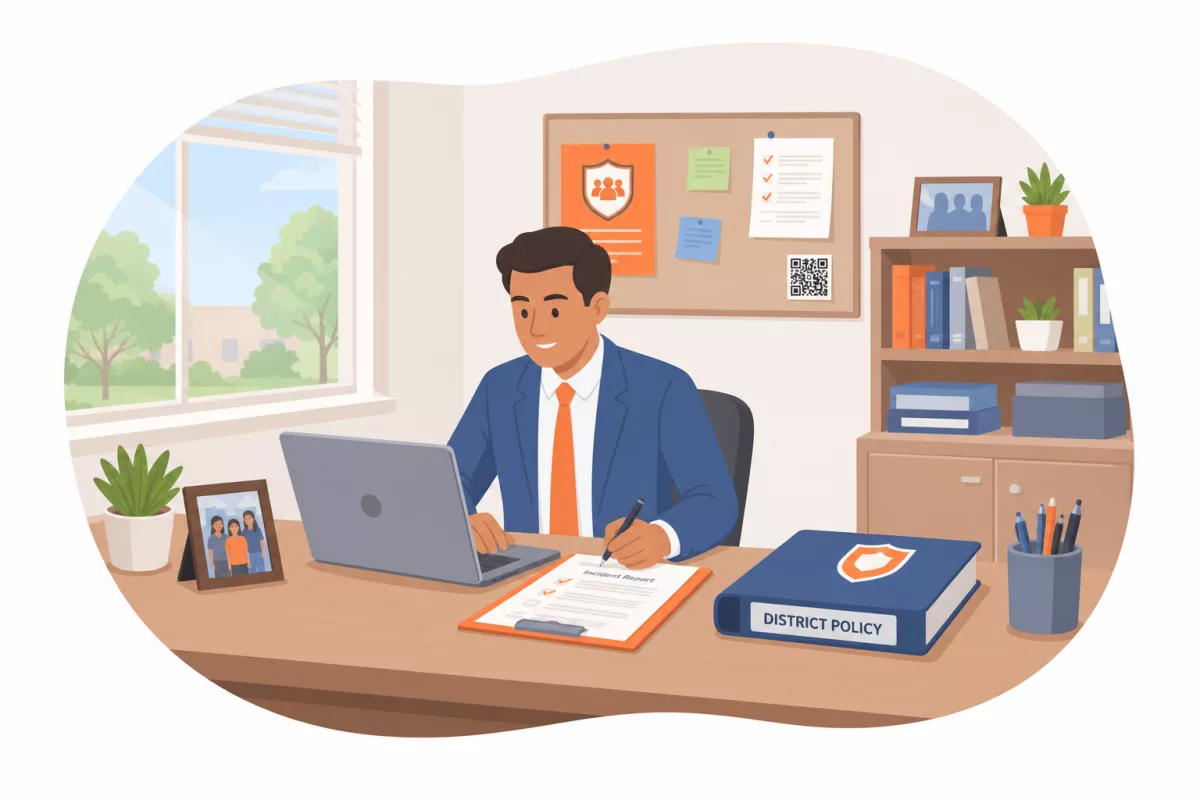
Here is the short answer to how to document bullying incidents for district policy: record every report promptly, in writing, using a consistent form. Capture who, what, when, where and who witnessed it. Use observable facts instead of conclusions. Log each response and follow-up with dates, and store the file securely under your district's retention rules. If someone outside your building can read the file and understand exactly what happened and what you did, your documentation is doing its job.
What a Defensible Bullying Record Contains
District policies differ, and state law shapes much of what you must collect, so start with your own policy and your state's requirements. Still, strong records across districts share the same core elements. Think of them as the minimum a reviewer, such as a superintendent, a board member, or an attorney, would expect to find.
The incident facts
- Date, time and location of the incident, plus the date and time it was reported to you.
- Who reported it and how (in person, email, phone, anonymous tip, staff observation).
- Who was involved: the student targeted, the student or students alleged to have caused harm, and any bystanders or witnesses.
- What happened, described specifically: words used, actions taken, any online platform involved.
- Whether it was part of a pattern, with references to earlier reports if they exist.
The institutional response
This half of the record is the one most often missing. Reviewers want to know what the school did after learning about the incident. Include when the investigation started, who conducted it, what interviews took place, what safety measures were put in place, what consequences or supports followed, and when you contacted families.
The outcome and follow-up
A record that stops at "student was spoken to" is incomplete. Note the follow-up check-ins you scheduled, what the student reported at each one, and the date the case was closed or escalated. If the behavior continued, that belongs in the file too.
Write Facts, Not Conclusions
The most common documentation error is not leaving things out. It is writing opinions as if they were observations. Compare two entries:
- Conclusion: "Marcus was aggressive and bullied Devon at lunch."
- Observation: "Per Devon and two students at the table, Marcus said 'nobody wants you here' and knocked Devon's tray onto the floor at approximately 12:10 p.m. in the cafeteria. Ms. Rivera, on lunch duty, saw the tray fall but did not hear the comment."
The second version tells the reader who said what, what the writer saw directly, and what came secondhand. It protects the student accused, the student targeted, and you. If the case is later reviewed, nobody can argue you decided the outcome before you investigated.
Quote when you can, attribute always
Use direct quotes for what students say, and attribute every statement to its source. Avoid labels such as "bully," "victim," "manipulative," or "attention-seeking." Words like "alleged," "reported," and "stated" are not legal hedging. They are accurate descriptions of what you know at that stage.
Key point: Whether an incident meets your district's legal definition of bullying is a determination, not a starting assumption. Document the facts first. Then record the determination separately, with the reasoning and the person who made it.
Separate your notes from the official record
Your raw interview notes, the formal incident report, and any personal reflections are different documents. Keep raw notes factual and dated, and be aware that in many places they may be requested or disclosed in a records request or legal proceeding. Do not put speculation or frustration in anything you would not want read aloud at a hearing.
A Step-by-Step Process You Can Standardize
Consistency matters more than elegance. If every staff member follows the same sequence, your records become comparable, and patterns become visible. Here is a workflow that fits most district policies.
1Capture the report the same day
Whoever first hears about an incident should write down what they were told within hours, not days. Memory degrades quickly, and details like exact wording or the order of events are the first to blur. Use the district form if one exists. If not, a simple template with the fields listed above will do.
2Route it to the designated person
Most policies name a specific administrator or coordinator who receives bullying reports. Teachers should not be left deciding whether something "counts." Make the rule simple: if a student reports it or you see it, it goes to the designated person, with a timestamp.
3Take immediate safety steps and note them
Before the investigation is complete, ask whether the targeted student needs a schedule adjustment, a check-in adult, or a changed seat on the bus. Write down what you did and why. Interim safety steps are among the first things a family will ask about.
4Interview separately and record each account
Speak with the targeted student, the student alleged to have caused harm, and witnesses individually. Record who conducted the interview, who else was present, the date, and the student's own words. Do not let witnesses compare stories first.
5Gather corroborating evidence
Where relevant, preserve screenshots, messages, video footage, photographs of injuries (by the nurse, not by a teacher), and staff observations. For digital incidents, capture the content with the date, username and platform visible before it can be deleted. Log where each item is stored.
6Record the determination and the response
State whether the conduct met your policy definition, which part of the policy applies, and what actions followed: discipline, restorative conversation, counseling referral, supervision changes, or other supports. Note the date families were notified and what you told them.
7Schedule and log follow-up
Put check-in dates on the calendar when you close the initial investigation. A common pattern is a short check-in within a week and another a few weeks later. Record what the student said each time. This is the evidence that your response worked, or the early warning that it did not.
Pro tip: Add a one-line "what happened next" field to your incident form that must be completed before a case can be closed. It forces the follow-up step to happen and gives you a ready answer when a parent asks, "What did you do about it?"
Handling Anonymous Reports and Informal Tips
Many of the earliest signals of bullying never arrive as formal complaints. A student mentions it in passing to a counselor. A note is slipped under a door. An anonymous report comes in through a QR code or a tip line. These still need to be documented, but they require careful framing.
An anonymous report is a lead, not a finding. Log it with the date, the wording of the report, and the steps you took to verify it, such as increased supervision in the location named, a quiet check-in with students who might be affected, or a review of camera footage. If you cannot confirm it, document that too. "Report received, increased hallway presence, no incident observed over two weeks, student groups checked in with" is a perfectly legitimate record.
Tools like WhispAlert can help here by timestamping anonymous submissions automatically and keeping them in one place, so a tip does not live only in someone's inbox. Whatever system you use, the principle is the same: every report gets a record, and every record gets a documented response.
Do not promise confidentiality you cannot keep
When students share concerns, be honest about who will need to know. Records may be accessible to parents under education records laws, and some information must be shared with the district or reported externally. Tell students plainly what you can protect and what you cannot.
Storage, Privacy and Retention
A well-written report loses its value if it is stored badly. Several practical questions deserve clear answers in your building.
- Where do records live? A single secure system, not a mix of email, paper folders, and personal notes.
- Who can access them? Limit access to staff with a legitimate educational need. Involved students' names should not be visible to everyone with log-in access.
- How long are they kept? Retention rules vary by state and district. Ask your records officer or district counsel, and do not destroy files informally.
- How are they shared with families? Learn what your district can disclose about other students involved. Typically, a family can be told what was done to address their child's situation, but not the discipline details of another student.
Keep targeted students' and accused students' files linked by incident but handled with care. When a student transfers, check what your policy and state law require you to share with the receiving school.
Turn Individual Records Into Patterns
Documentation serves two audiences. The first is the reviewer who needs to see that you followed policy in one case. The second is you, looking across cases. Once records are consistent, you can ask useful questions: Do incidents cluster in one hallway or on one bus route? Do they spike after certain events? Are some groups of students reporting more than others, or less? Are repeat cases appearing because the first response did not hold?
Review your records on a regular schedule, monthly works for many schools, and look at categories rather than names. Patterns in location, time of day, type of conduct, and grade level often point to fixes that no single case would reveal, such as adding supervision at a particular spot or running a targeted lesson for one grade. Some platforms, including WhispAlert, compile this kind of summary automatically, but a simple spreadsheet and a standing meeting can accomplish the same thing.
Train staff, then audit a sample
Documentation quality is mostly a training issue. Run a short session using a realistic scenario and have staff write the report, then compare entries. Twice a year, pull a handful of closed cases and check them against the list of required elements. Look for missing follow-ups, loaded language, and gaps between report date and response date. Treat what you find as feedback for the process, not as blame.
Bullying Documentation Checklist:
- Record every report in writing on the same day, with date, time and reporter
- Describe what was seen or said, using quotes and attribution instead of labels
- Log interim safety measures taken for the targeted student
- Interview students separately and note who conducted and attended each interview
- Preserve and log digital and physical evidence with its storage location
- Record the policy determination, reasoning, and the person who made it
- Document family notifications and what was communicated
- Schedule follow-up check-ins and record each outcome before closing the case
- Store files securely, restrict access, and follow your retention schedule
- Review aggregate patterns monthly and audit a sample of cases twice a year
Good documentation will not stop bullying on its own. What it does is make your response visible, consistent and accountable, to families, to the district, and to yourselves. Over time, that visibility is often what helps a school notice a problem early enough to fix it.
Related articles
Ready to Make Your School Safer?
Join hundreds of schools already using Whispalert to create safer, more supportive learning environments.
Get Started Today