School Counselor Checklist After a Self-Harm Disclosure
A student sits down in your office, pulls their sleeve back or says quietly that they have been hurting themselves, and the next ten minutes matter more than almost anything else on your calendar. Here is the short version of a school counselor checklist after a self-harm disclosure: stay with the student, stay calm, ask directly about suicidal thoughts, complete a structured risk screening, involve a parent or guardian (unless that would put the student at risk), build a written safety plan, document carefully, and schedule follow-up within days, not weeks.
Most counselors know these steps in theory. The trouble is that a disclosure rarely arrives at a convenient time, and adrenaline makes people skip things. This article walks through the sequence in the order you will actually need it, with the reasoning behind each step so you can adapt when the situation does not match the flowchart. Always defer to your district's protocol and your state's legal requirements where they differ from what is written here.
The School Counselor Checklist After a Self-Harm Disclosure
Think of the first hour in four phases: stabilize, screen, decide, and connect. Each one builds on the last.
1Stay with the student and keep the space calm
Do not leave the student alone, even to grab a form or make a call. If you need another adult, send a message through a colleague or use a phone in the room. Check quickly for urgent physical needs: fresh wounds that need first aid, signs of blood loss, or evidence the student has swallowed something. If there is any medical concern, call the nurse or emergency services first. Screening can wait for a student who is not physically safe.
Your tone matters more than your words. Shock, panic, or visible disappointment can teach a student that disclosing was a mistake. A steady voice, an unhurried pace, and plain language tell them the information is something you can handle.
2Thank them and be honest about confidentiality
Begin by acknowledging how hard it was to say. Then be truthful about what happens next. You cannot promise to keep this secret, and trying to will damage trust later when you have to break the promise. A line like this works well: "I'm really glad you told me. My job is to keep you safe, so I may need to involve some other people, and I'll tell you who and why before I do."
Students often fear being punished, hospitalized, or having their parents explode. Naming those fears and answering them honestly lowers defensiveness and gets you better information.
3Ask directly about suicide
Self-harm and suicidal thinking are related but not identical. Many students who self-injure are trying to cope with overwhelming emotion, not end their lives. Others are having suicidal thoughts and describing them as self-harm because it feels safer to say. You cannot tell which without asking.
Ask plainly: "Are you having thoughts of killing yourself?" Asking does not plant the idea. Vague or euphemistic questions tend to produce vague answers. Then follow your district's structured screening tool. Many schools use the Columbia Suicide Severity Rating Scale (C-SSRS) screener or the Ask Suicide-Screening Questions (ASQ) tool. If your building has not named a standard tool, ask your district why, because improvising under pressure produces inconsistent decisions.
Key point: A screening tool does not replace your judgment, and your judgment should not replace a screening tool. Use both. When the two disagree, take the more cautious path and consult a colleague or crisis team.
4Gather the details that shape risk
Beyond the screener, you need context. Ask, in a conversational way:
- What did you do, and when did it last happen?
- How often has this been happening, and is it getting more frequent or more severe?
- What was going on right before? (A conflict, a breakup, a failing grade, something online, something at home.)
- Do you have any plan to hurt yourself more seriously? Do you have access to what you would use?
- Who else knows? Has anyone else been hurt or talked about it?
- What has helped, even a little, in the past?
Listen for protective factors as well as warning signs: a trusted adult, a reason for living the student can name, a willingness to accept help, and a future they still care about. Those belong in your assessment and your safety plan.
5Decide the level of response
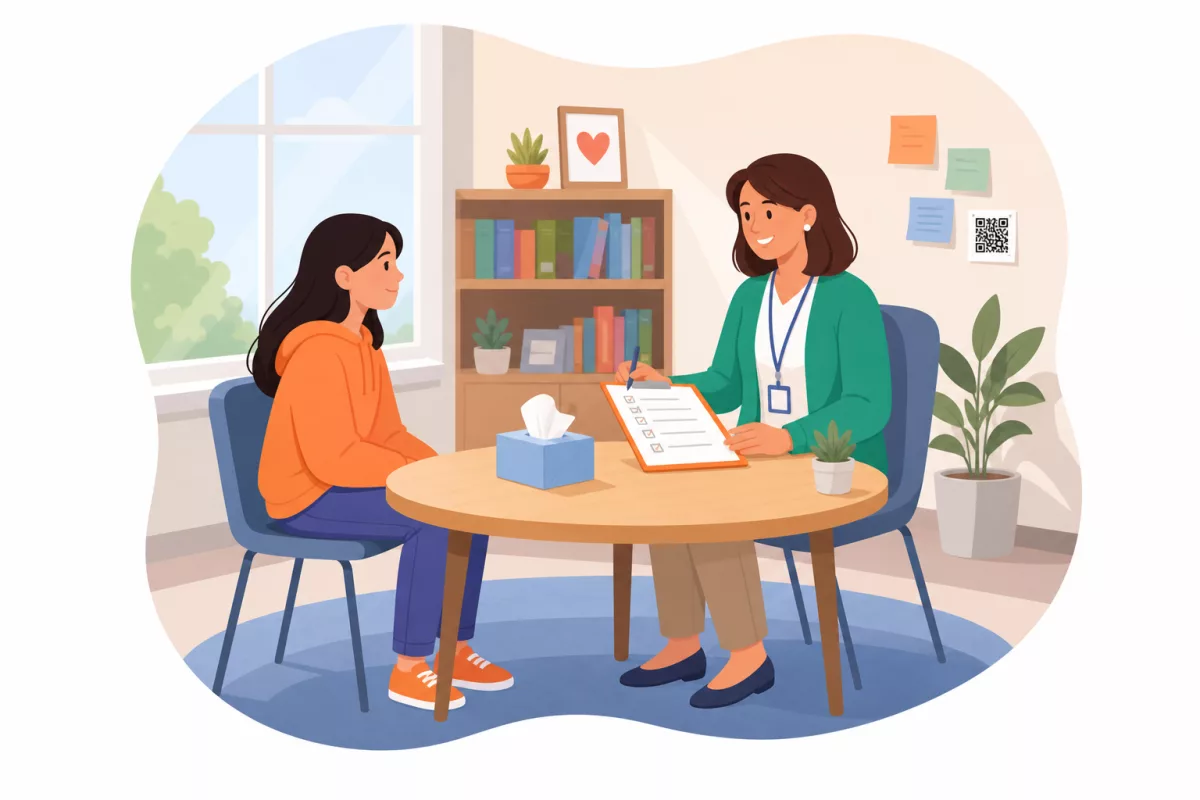
Based on screening and context, you will land in roughly one of three places. Your district protocol defines the exact thresholds, but the general pattern looks like this:
- Imminent risk: The student has a plan, intent, or means, or cannot agree to stay safe. Maintain constant supervision, contact a parent or guardian, and arrange an emergency evaluation through a crisis team, mobile crisis service, or emergency department. Call 911 if the student cannot be safely transported by family.
- Elevated but not imminent risk: There are suicidal thoughts without a plan or intent, or recent self-injury that is escalating. Involve the family the same day, build a safety plan, and strongly recommend a prompt clinical assessment, ideally within a day or two.
- Lower risk: Non-suicidal self-injury with no current suicidal thinking, and solid supports. You still notify the family in most cases, create a coping plan, recommend outside counseling, and schedule close follow-up.
If you are unsure which category fits, treat it as the higher one until a second qualified person has weighed in. Consulting a school psychologist, social worker, or administrator is part of good practice, not an admission that you are out of your depth.
Contacting Parents and Handling Hard Cases
In most situations, you will call a parent or guardian the same day, and the way you do it shapes whether the family follows through. Open with care, not alarm: "Your child trusted me with something important today, and I want us to work together on supporting them." Share the facts you need to, describe the safety steps already taken, and give specific next-step recommendations rather than a general "keep an eye on them."
Ask the student beforehand how they would like the conversation to go. Some want to be in the room or on the phone. Offering that choice restores a little control and often reduces the sense of betrayal.
When a parent call might make things worse
Occasionally, home is part of the problem. If the student describes abuse, neglect, or credible fear of a violent reaction, do not simply call and hope. Consult your administrator and follow mandated reporting rules, which in most places apply immediately. Your district's protocol and local child protective services will guide how and whether to notify the family. Document the reason clearly.
Lethal means and the home environment
One of the most useful things you can say to a parent is also one of the least comfortable: reduce access to means. Encourage them to lock up or remove firearms, store medications (including over-the-counter pain relievers) securely, and secure sharp objects, at least for now. Time and distance between an impulse and a method save lives, and this advice is more effective when delivered without judgment and with a concrete suggestion.
Pro tip: Give parents a one-page handout before they leave the call or meeting: the 988 Suicide and Crisis Lifeline (call or text 988 in the US), your local mobile crisis number, warning signs to watch for, and the safety plan. Families under stress forget most of what they hear in a phone call.
Build the Safety Plan and Write It Down
A safety plan is a short, written, student-owned document, not a contract. Research on "no-suicide contracts" has not supported them, and they can leave a student feeling that a signature is the only thing standing between them and a bad decision. Instead, use a collaborative structure such as the Stanley-Brown Safety Planning Intervention, which includes:
- Personal warning signs (thoughts, feelings, situations)
- Coping strategies the student can do alone
- People and places that offer distraction
- Trusted people to ask for help
- Professionals and crisis lines, with numbers
- Steps to make the environment safer
Use the student's own words wherever possible. Give them a copy, with their permission put it on their phone, and share a version with the parent or guardian.
Document what you did and why
Good documentation protects the student and you. Record the date and time of the disclosure, what the student said (quote directly where possible), the screening tool and results, your risk determination, who you consulted, who you contacted and when, what was recommended, and what the family agreed to. Keep it factual: avoid speculation, labels, or loaded language. Store it according to your district's policy, and be aware of how FERPA and any state mental-health privacy rules affect who can see it.
Follow-Up Matters More Than the First Meeting
The days after a disclosure are a vulnerable period. A student who has revealed something painful may feel exposed, relieved, or both. Plan for a check-in within one school day, then regularly for the next several weeks. Keep these brief and predictable: a quick conversation at a set time often works better than a dramatic "how are you really doing" meeting.
Re-entry after a hospital or crisis evaluation
If the student was hospitalized or evaluated off-site, meet with the family before they return. Review discharge recommendations, update the safety plan, decide who on staff needs to know (only those who truly need to), and agree on how absences and make-up work will be handled. Academic pressure can quietly reignite a crisis, so a temporary adjustment in workload is often wise.
Watch for ripple effects
Self-harm can spread through friend groups, especially when it is discussed in detail or shared on social media. Do not question the student's peers about specifics. If a friend raised the alarm, thank them privately, tell them they did the right thing, and check on how they are coping, because carrying a secret like this is heavy. If you notice other students showing similar signs, bring in your crisis team and consider a measured response, without assemblies that describe methods.
Catch the Next Disclosure Earlier
Many students will never walk into a counselor's office on their own. They tell a friend, post something, or write a note, and the school only learns later. Anonymous reporting channels can close that gap. A tool like WhispAlert, which lets students submit a report by scanning a QR code posted around the building, gives a worried peer a low-risk way to say "someone I know is hurting themselves" before the situation escalates. Whatever channel you use, make sure someone is assigned to review reports daily and that the response path leads straight into the steps above.
Take care of the person doing the work
Counselors absorb a great deal of distress. After a serious disclosure, debrief with a colleague or supervisor, and do not carry the decision alone. Your own steadiness is a safety resource for students, and it needs maintenance.
Quick checklist for the first day:
- Stay with the student and address any medical needs first
- Explain the limits of confidentiality honestly and kindly
- Ask directly about suicidal thoughts and use your district's screening tool
- Consult a second qualified colleague on risk level
- Contact the parent or guardian, or follow mandated reporting if home is unsafe
- Discuss securing firearms, medications, and other means
- Complete a written safety plan with the student and share it appropriately
- Provide 988 and local crisis numbers in writing
- Document the disclosure, screening, decisions, and contacts
- Schedule a check-in within one school day and a longer follow-up plan
Related articles
Ready to Make Your School Safer?
Join hundreds of schools already using Whispalert to create safer, more supportive learning environments.
Get Started Today