How to Spot and Respond to Cyberbullying in School Group Chats
A counselor gets a visit from a seventh grader who has stopped eating lunch in the cafeteria. Nothing happened at school, she says. Nobody said anything to her face. But there is a group chat with 14 classmates, and last weekend someone posted a screenshot of her photo with a caption. Eleven people reacted with a laugh emoji. Two replied with worse. The adults in the building had no idea the chat existed.
This is what cyberbullying looks like for most schools now. It is less often a public post on a social feed and more often a closed group chat: small, fast, semi-private, and invisible to the people responsible for student safety. Spotting it takes a different kind of attention than spotting a hallway altercation. Responding to it takes a clear process, because the first 48 hours often decide whether the situation settles or escalates.
Why Group Chats Change the Dynamics of Bullying
Traditional bullying usually has a visible target, a visible aggressor, and a few witnesses. Group chats rearrange all of that.
- The audience is built in. Every message is performed for a crowd. That raises the social reward for cruelty and raises the cost of objecting.
- It never ends at the bell. A student can be targeted at 11 p.m. on a Saturday, and the messages are waiting when they wake up.
- The content persists. Screenshots get forwarded, edited, and moved into new chats. A joke made once can circulate for weeks.
- Responsibility diffuses. When ten students watch and one types, each of the nine feels barely involved. Bystanders often feel uncomfortable but see no safe move.
- Roles blur. The student who was targeted last month may be the one posting this month. Group chats shift quickly, and so do alliances.
That last point matters for how you respond. If you treat every case as a simple story of one villain and one victim, you will often miss the real structure of the group, and your intervention will miss with it.
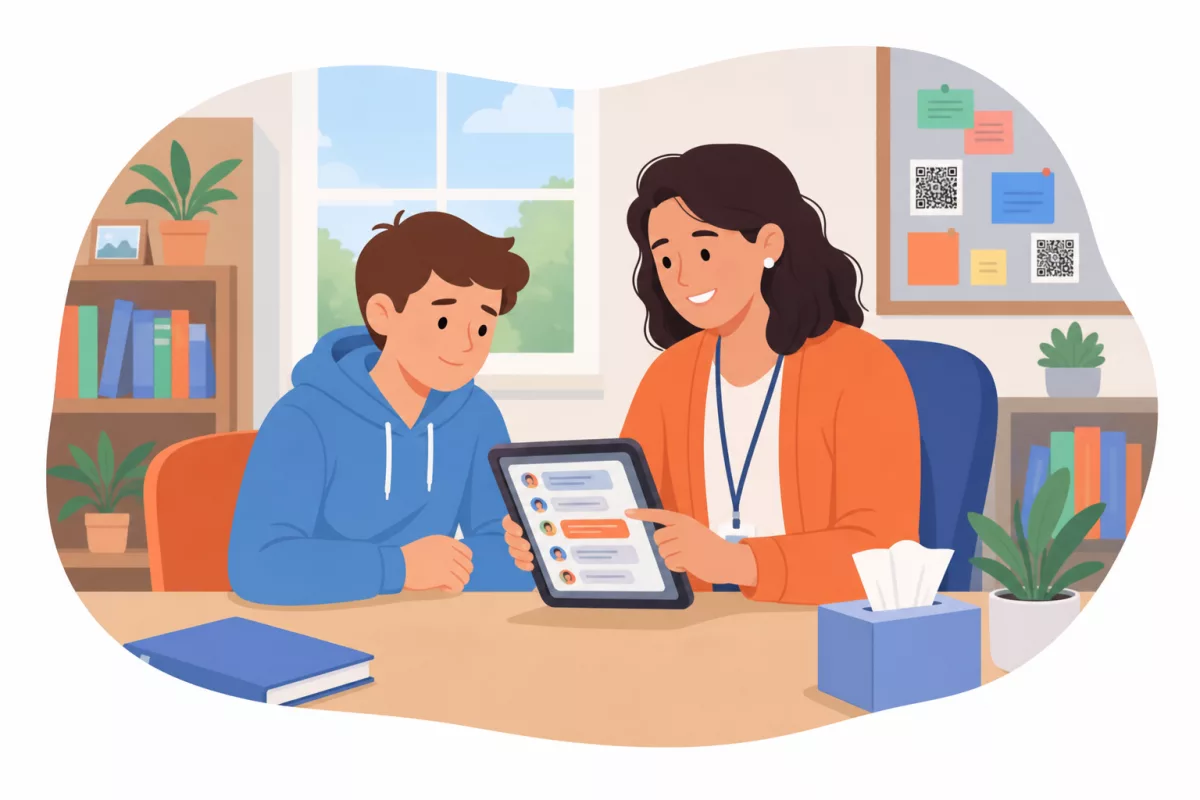
How to Spot Cyberbullying You Cannot See
You will rarely get to read the chat. What you can see are the effects around it. Most schools find out through a pattern of small signals, not one dramatic report.
Changes in Student Behavior
Look for shifts that cluster together, not single events. A quiet day means little. A two-week pattern means something.
- Sudden reluctance to attend school, especially on specific days or after weekends
- Frequent trips to the nurse or counselor with vague physical complaints
- Withdrawal from a friend group that was previously close
- Visible distress after checking a phone, or hiding the screen when adults approach
- Dropping grades or work that is suddenly incomplete
- Abrupt changes in how a student talks about their phone: refusing to use it, or being unable to put it down
Signals in the Peer Environment
Sometimes the clearest sign is not the target but the room. Teachers are well placed to notice these.
- Inside jokes that make a particular student go silent or leave
- Students glancing at one another's phones when a certain classmate speaks
- A group that goes quiet when an adult approaches
- Sudden seating changes or one student being left out of group projects
- Students referring to "the chat" or "what was said" in a way that stops when you ask
What Students Tell You Sideways
Young people rarely say "I am being cyberbullied." They say things like "I just don't like it here," "my friends are being weird," or "it's drama, it's fine." Treat those phrases as invitations to ask a second question. A calm "What kind of weird?" often opens more than a formal meeting does.
Key point: Students often do not report cyberbullying because they fear losing their phone, fear retaliation, or believe adults will make it worse. Your first reaction to a disclosure teaches every student in the building whether it is safe to tell. Respond to the person before you respond to the problem.
How to Respond: A Five-Step Process
A good response is calm, documented, and proportionate. Here is a sequence that works for most incidents, whether the report comes from a student, a parent, a teacher, or an anonymous tip.
1Support the Targeted Student First
Before gathering evidence or contacting anyone, talk to the student privately. Thank them for telling you. Tell them what you will do and what you will not do without talking to them first. Ask what they need right now: space, a schedule change, a check-in person, or simply someone to know.
Avoid advice like "just block them" or "stay off your phone." Students hear this as being asked to give up their social lives because someone else behaved badly. It also does not stop the content from circulating.
2Preserve the Evidence
Ask the student or family to take screenshots that show names, dates, and timestamps. Do not ask the student to forward the messages to many people, and do not delete anything. If an adult needs to view the content, do it with the student's consent and a second staff member present. Record what you saw, when, and who was present.
If images of a minor are involved, particularly intimate ones, stop. Do not copy, forward, or screenshot them yourself. Follow your district policy and legal reporting requirements, and bring in your administrator and, where required, law enforcement.
3Assess Severity and Risk
Not every unkind message is a crisis, but some are. Ask a few direct questions:
- Does the content include threats of violence or self-harm, or encouragement of either?
- Is it a one-time incident or a sustained pattern?
- Does it target a protected characteristic such as race, disability, religion, gender, or sexual orientation?
- Is the targeted student showing signs of acute distress?
- Does it involve sexual content, impersonation, or sharing private information?
Any "yes" to the first, fourth, or fifth question moves the case up your priority list. A student who is hinting at self-harm needs a same-day conversation with a counselor or mental health professional, not a scheduled meeting next week.
4Address the Conduct, Not Just the Content
Even when the chat was created off campus and on personal devices, schools generally can respond when it creates a substantial disruption at school or interferes with a student's access to education. Check your district's policy and legal guidance, since the details vary by state and context.
When you talk to students who participated, separate the roles. The creator of the chat, the main poster, the students who laughed, and the ones who stayed silent do not all need the same response. A restorative conversation may be right for some. Formal discipline may be right for others. What matters is that the response names the harm and requires some form of repair.
Pro tip: In conversations with students who took part, ask "What do you think it was like to be on the other end of that?" before you ask "Why did you do it?" The first question invites empathy. The second usually invites a defense.
5Communicate, Follow Up, and Watch for Retaliation
Contact the families of the targeted student and the students involved, usually separately. Share what happened, what the school is doing, and what the family can do at home. Be careful about privacy: you generally cannot share the discipline outcomes of other students.
Then follow up. Check in with the targeted student after three days, a week, and a month. Retaliation is common, especially if the targeted student is believed to have "told." A short, regular check-in does more than any single meeting.
Working With Parents Without Losing the Student's Trust
Parents are essential partners, and also a source of hesitation for students. Many young people avoid reporting because they believe a parent will take away their phone or storm into the school. Be honest with students about when parents will be contacted, and be honest with parents about what students need.
Some language that helps when speaking with families:
- "Your child did the right thing by telling someone."
- "We recommend keeping the phone available for now, because the messages are evidence and because your child may need it to stay connected to supportive friends."
- "If you see new messages, please screenshot them and send them to us instead of replying."
For parents of students who posted harmful content, expect defensiveness. Start with facts and the impact on the other student, and move to next steps. Most parents want to help once they have stopped feeling accused.
Making It Easier for Students to Tell You Early
Most of what you can do in the response phase would be easier if you had heard sooner. The usual barrier is not that students do not care. It is that telling feels risky. They worry about being labeled a snitch, being identified, or being the next target.
Lowering that barrier is one of the highest-leverage things a school can do. A few approaches that tend to help:
- Offer more than one way to report. Some students will walk into the counselor's office. Many will not. Give them options, including anonymous ones.
- Make reporting visible. Posters and announcements only work if students know exactly what happens after they report and who sees it.
- Close the loop where you can. You cannot share everything, but you can say "we looked into it and took action." Silence teaches students that reporting does nothing.
- Teach upstander skills. Short, practical lessons on what to do in a group chat (screenshot, do not pile on, message the target privately, tell an adult) give bystanders something to do other than watch.
- Review patterns, not just incidents. A single report is a case. Several reports across a month might reveal that one grade level, one app, or one weekend routine is where the trouble concentrates.
An anonymous reporting tool such as WhispAlert can be one piece of this. Students scan a QR code posted around campus and describe what they saw without giving their name, and administrators can see trends over time instead of piecing together isolated tips. It does not replace relationships with trusted adults, but it can surface the things students would not say out loud.
Cyberbullying Response Checklist for Staff:
- Speak with the targeted student privately and listen before advising
- Preserve screenshots with names, dates, and timestamps, and never delete originals
- Screen immediately for threats, self-harm indicators, and sexual content
- Follow district policy and legal reporting duties for anything involving images of minors
- Meet with each involved student according to their role in the situation
- Contact families with clear, privacy-conscious communication
- Schedule check-ins at three days, one week, and one month
- Review reports monthly for patterns across grades, groups, and platforms
Final Thoughts
You will not be able to read every group chat, and you should not try. What you can do is build a school where students notice harm, know what to do about it, and trust that the adults will respond with care. Cyberbullying in group chats thrives on silence and diffused responsibility. Clear signals, a steady response process, and easy ways to speak up work against both.
Related articles

Ready to Make Your School Safer?
Join hundreds of schools already using Whispalert to create safer, more supportive learning environments.
Get Started Today